Is your aircon running all night but never quite getting cold?
It could be low gas. An aircon gas top-up sounds like a quick fix, but there’s a catch you should know about first.
Brian started Cool Earth Aircon in 2007, and our Jurong team still follows one rule. Low gas always has a cause, and finding that cause matters more than the top-up itself.
Here’s how we check, what the warning signs look like, and when gas isn’t the problem at all. Grab a cuppa and read on.
Why Low Gas Always Means a Leak
An aircon is a sealed loop. Refrigerant flows between the indoor coil and the outdoor compressor, picking up heat inside and releasing it outside. It isn’t burned or used up, so if the level is low, some has escaped.
Leaks tend to start in the same few places:
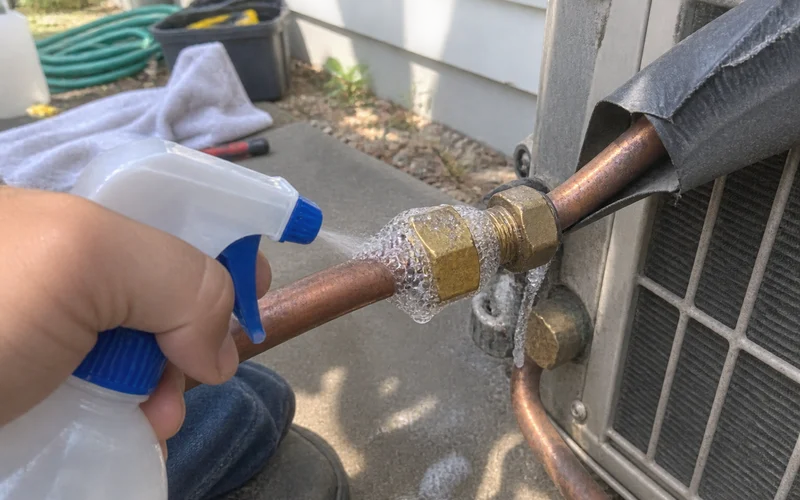
- The flare nut joints where the copper piping connects to each unit
- The service valve on the outdoor condenser
- Joints that were poorly flared when the unit was first installed
Vibration and age make all three worse.
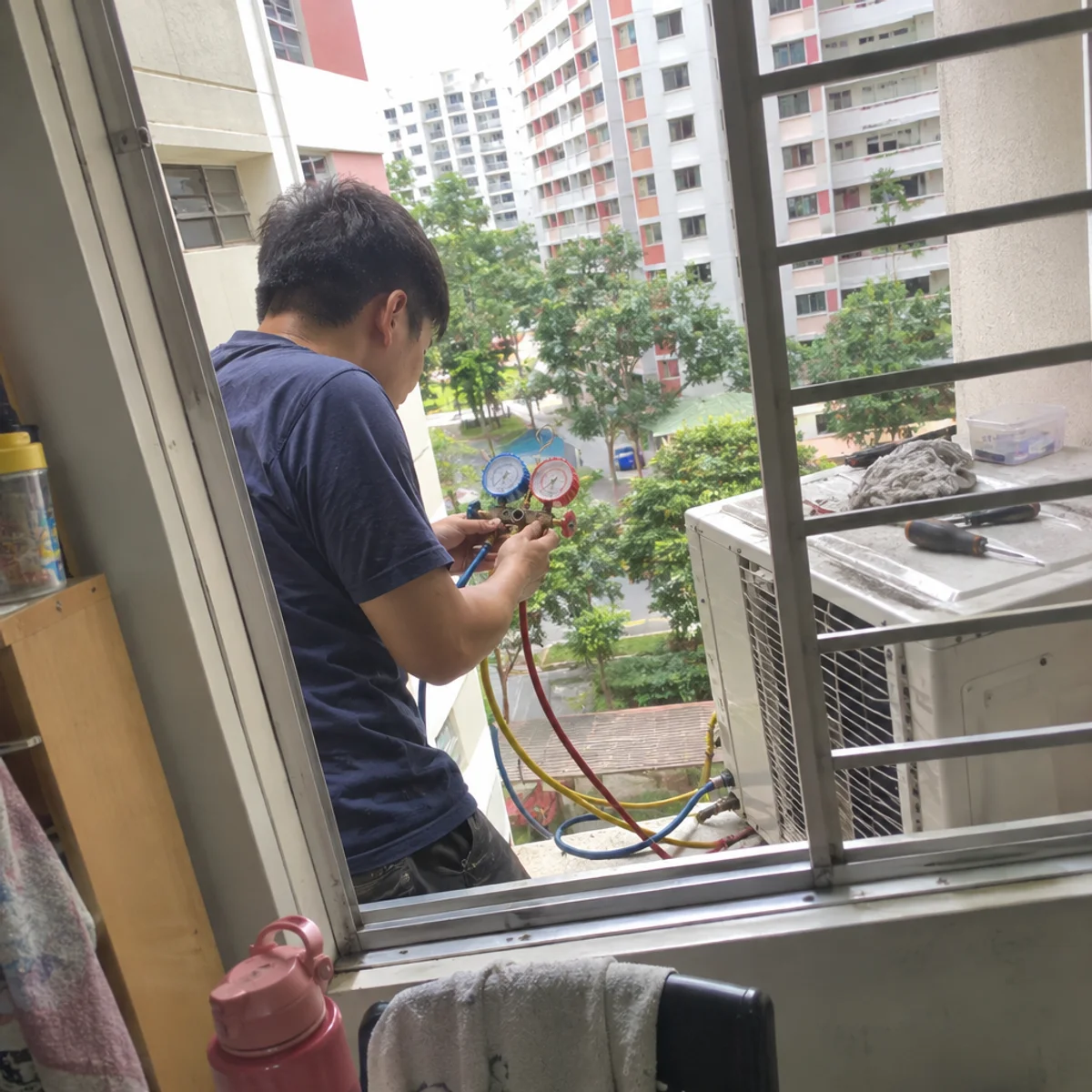
That’s why we never top up blindly. A pressure test and leak detection come first. Otherwise you could pay for a top-up that leaks away within weeks.
The cost of skipping this step adds up. Coogle Aircon, a Singapore servicing company, says fixing a refrigerant leak typically costs $150 to $350, depending on where the leak is and how bad it is. Topping up a leaking system just delays that bill.
Signs Your Aircon Is Low on Refrigerant
- Cooling that fades slowly over weeks or months
- A soft hissing or bubbling sound near the unit or pipes
- Ice on pipe or frost on the outdoor service valve
- A compressor that runs non-stop and never cuts off
- Oily marks around pipe joints, since refrigerant carries oil with it
- A rising electricity bill with no change in use
Ice is the sign most flat owners spot first. Snowflake Aircon points out that a blocked filter or a faulty expansion valve can also cause it. So ice alone doesn’t prove the gas is low, but ice plus weak cooling is a strong hint.
If you see ice, switch the unit off and let it thaw. Running it iced up strains the compressor.
Which Refrigerant Does Your Unit Use?
| Refrigerant | Found in | Notes |
|---|---|---|
| R22 refrigerant | Older non-inverter units | Still serviceable; plan for replacement over time |
| R410A refrigerant | Many inverter units | Common in condos and older BTOs |
| R32 refrigerant | Newer inverter units | Common in recent BTO flats |
The refrigerant type is printed on the outdoor unit label. We charge the correct gas to the level your unit is designed for. Mixing gases or overcharging hurts performance.
The R22 note in the table matters. As an Article 5 party to the Montreal Protocol, Singapore has to phase out HCFCs like R22 completely by 1 January 2030. Supply will keep tightening, so a unit that needs repeated R22 top-ups is a good candidate for replacement.
R32 is the newer standard. FC Aircon Servicing notes it has a global warming potential of 675, while Homejourney says R410A sits above 2,000. Existing R410A and R22 systems can’t simply switch to R32, though. A change means a new unit.
If you have 2 to 4 wall-mounted units, check every outdoor label. Units installed in different years can use different gases.
Top-Up or Something Else?
Low gas is only one reason for weak cooling. A dirty coil, a blocked filter or a failed part can feel exactly the same.
If the pressure reading is normal, we’ll say so and point you to the real fix, often a chemical wash or a part repair. See aircon not cold repair for the full diagnosis.
Catching Leaks Early
General aircon servicing every 3 to 4 months includes a refrigerant pressure check, which spots slow leaks before cooling drops. Alva Aircon notes that NEA recommends servicing every three months, so this schedule sits right in line. Our guide on what happens during general servicing lists every step.
Not sure if your unit needs an aircon gas top-up or just a good clean? Book a pressure check with us. We’ll find the leak first, then fix it properly.