Is your aircon running but only blowing lukewarm air? It’s a miserable feeling in a Jurong West or Jurong East flat, especially when the bedroom unit is the one that gives up at night.
Our team at Aircon Servicing Jurong is the local arm of Cool Earth Aircon, which Brian started in 2007 as a one-man workshop. Most aircon not cold repair calls we get from HDB owners turn out to be simple, and some cost very little to fix.
Here’s how we sort out what’s wrong, so you know what to expect before anyone touches your unit.
Three Common Reasons an Aircon Stops Cooling
1. Dirty filter or coil
This is the most common cause and the cheapest to fix. Dust on the filter and evaporator coil blocks airflow, so the unit can’t pull heat out of the room.
You may notice weak air from the vents and a room that takes ages to cool. Some units also smell dusty or musty when they start.
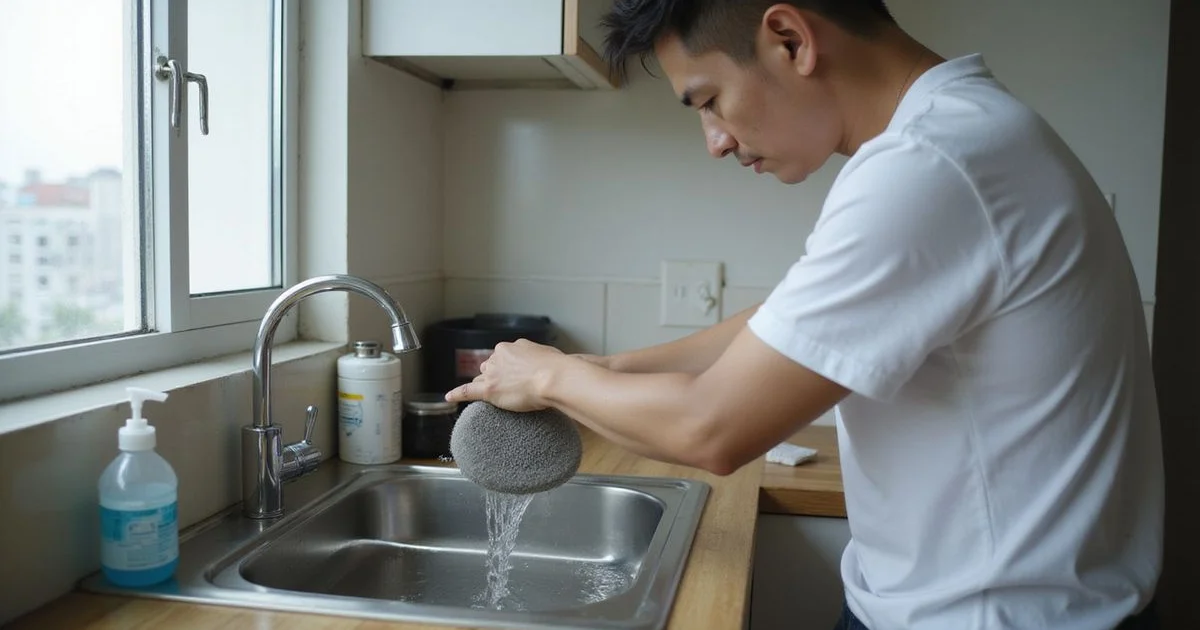
You can wash filters at home. Helpling’s haze guide suggests checking them every one to two weeks when the air outside is bad, and other Singapore servicing guides suggest a wash every two to three weeks in normal use. A coated coil is a different story, and it needs a chemical wash.
2. Low refrigerant
Refrigerant doesn’t get used up. If a unit is low on R410A refrigerant or R32 refrigerant, it has a leak somewhere, often at a flare joint.
Mitsubishi Electric Singapore says low refrigerant can come from an installation undercharge or a leak. Adding gas alone won’t cure a leak, so the leak has to be found and repaired.
Watch for these signs:
- Cooling that fades over weeks or months
- A hissing sound from the indoor unit or pipes
- Ice on coil or on the copper pipe
- A unit that needs gas every year or two
That last one is a giveaway. According to aircons.sg, R32 has been the standard in most new Singapore units since 2019, and a unit that needs gas every one to two years usually leaks at its flare joints, valves or corroded copper piping.
You also can’t swap one gas for the other. A unit built for R410A can’t simply be switched to R32, so the fix is always to find the leak and repair it. A gas top-up with a leak check fixes it properly.
3. A failed part
A weak capacitor can stop the compressor or fan from starting. A faulty thermistor can tell the unit the room is already cold. A worn fan motor moves too little air.
Capacitors catch a lot of owners out. Snowflake Aircon Services documented a Jurong West outdoor unit that buzzed, clicked and cut out, which sounded like a dead compressor. The cause was a small capacitor, which costs far less to replace.
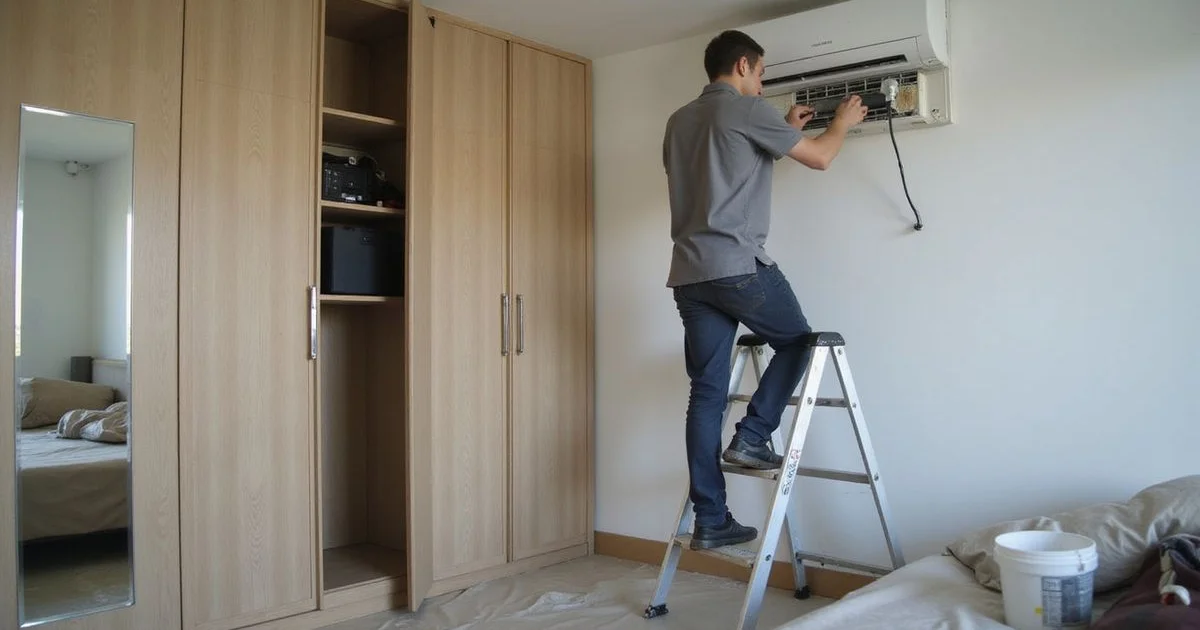
That’s why we test before we replace anything. A part swap only makes sense once the readings point to it.
How We Diagnose a Warm Aircon
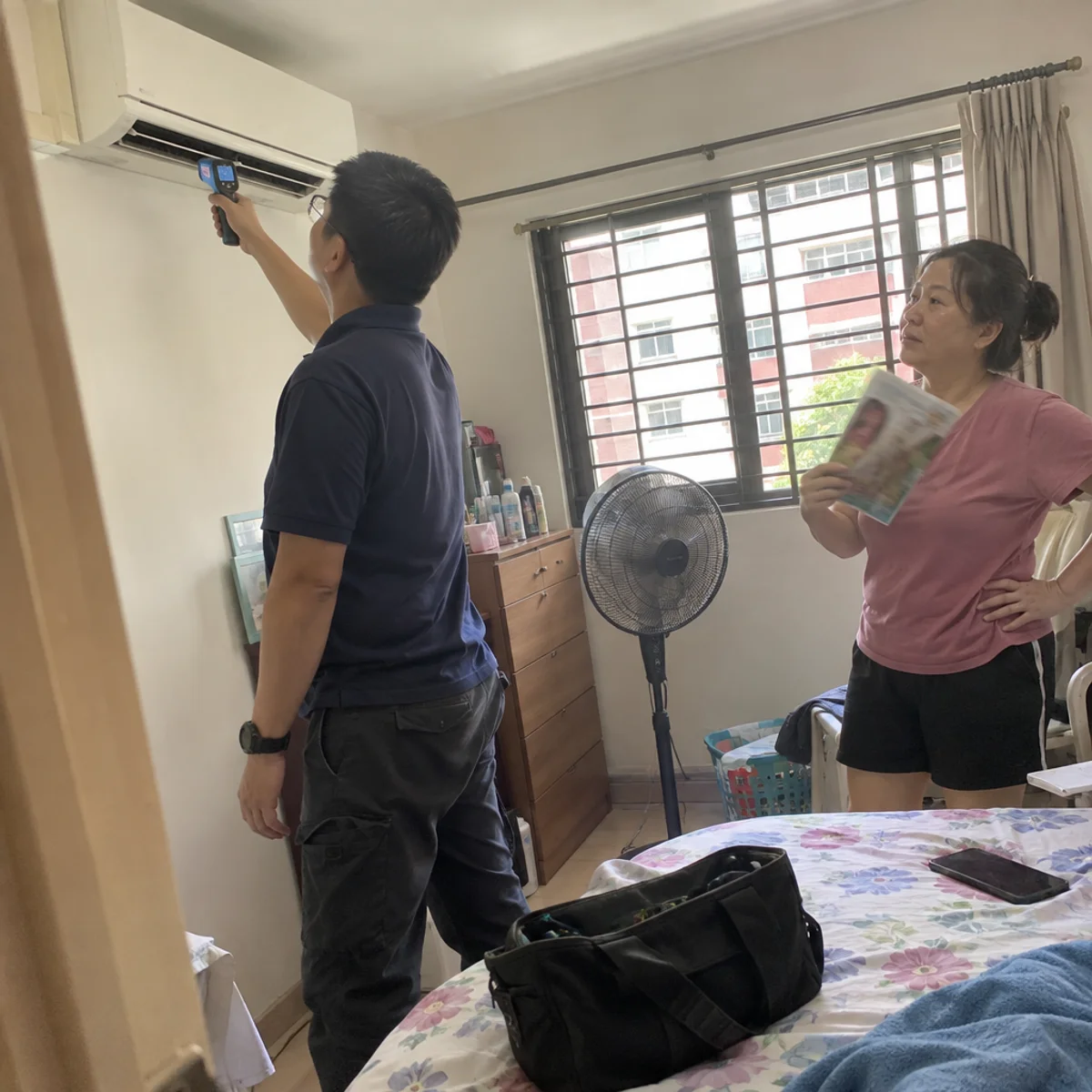
We start with a delta-T temperature check. We measure the air going into the indoor unit and the air coming out.
A healthy unit shows a clear drop. Air-conditioning guides commonly cite 15 to 20°F (roughly 8 to 11°C) as a good range. A small drop tells us something is wrong and points us in the right direction.
From there, we check:
- Filters and coil condition
- Drain pan and line, since a blocked drain can trip some units
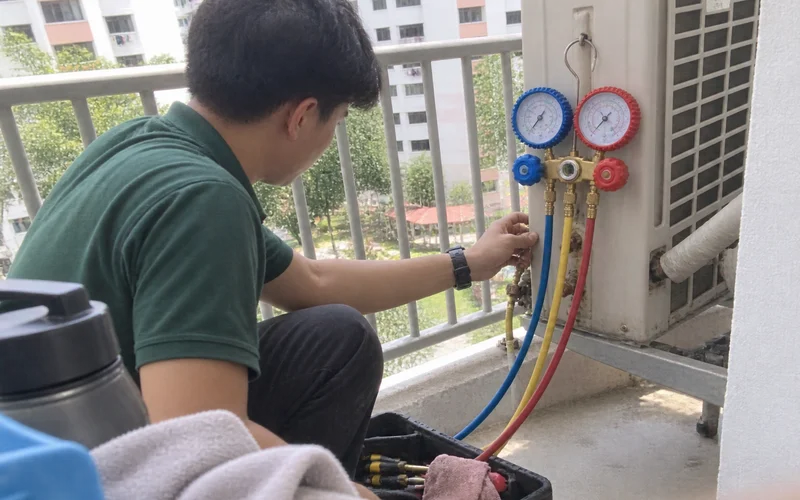
- Refrigerant pressure at the condenser unit on the ledge
- Capacitor, fan motor and contactor readings
- Sensors and error codes on the PCB
Only then do you get a quote. We won’t top up gas on a unit that simply needs cleaning.
Symptoms and Likely Causes
Find your symptom in the table below to get a rough idea of the cause. It’s a starting point, not a verdict, because several faults can look alike.
| What you notice | Most likely cause | What to do first |
|---|---|---|
| Weak airflow, dusty smell | Dirty filter or coil | Wash the filters |
| Cooling fades over months | Slow refrigerant leak | Book a leak check |
| Ice on the pipe or coil | Low refrigerant or blocked airflow | Switch off and let it thaw |
| Outdoor unit silent | Capacitor, contactor or wiring | Switch off and call us |
| Cold, then warm, then cold | Thermistor or compressor overheating | Note when it happens and tell us |
| One room cold, one warm | Fault on one branch of a multi-split system | Tell us which room is affected |
Ice deserves a closer look. Carrier’s HVAC guidance says a frozen coil won’t fix itself. Turn the system off to let it thaw, then deal with the root cause, usually restricted airflow or a refrigerant leak.
What You Can Check Before Calling
A few quick checks can save you a visit. Run through these first:
- Make sure the remote is on cool mode, not fan or dry.
- Check the set temperature. Some Singapore servicing guides suggest 25°C, since 18 to 20°C makes the compressor work much harder.
- Wash the filters if they look grey.
- If you see ice, switch the unit off.
If the unit still blows warm air, WhatsApp us with your block, your unit’s brand and a quick photo or video. We’ll tell you whether it sounds like a clean, a gas leak check or a part test.
Our guide on cleaning filters yourself shows what’s safe to do at home. Anything past the filter, such as the coil, the gas or the outdoor unit, is best left to us. Message us today and we’ll sort out your aircon not cold repair with a proper diagnosis first.